
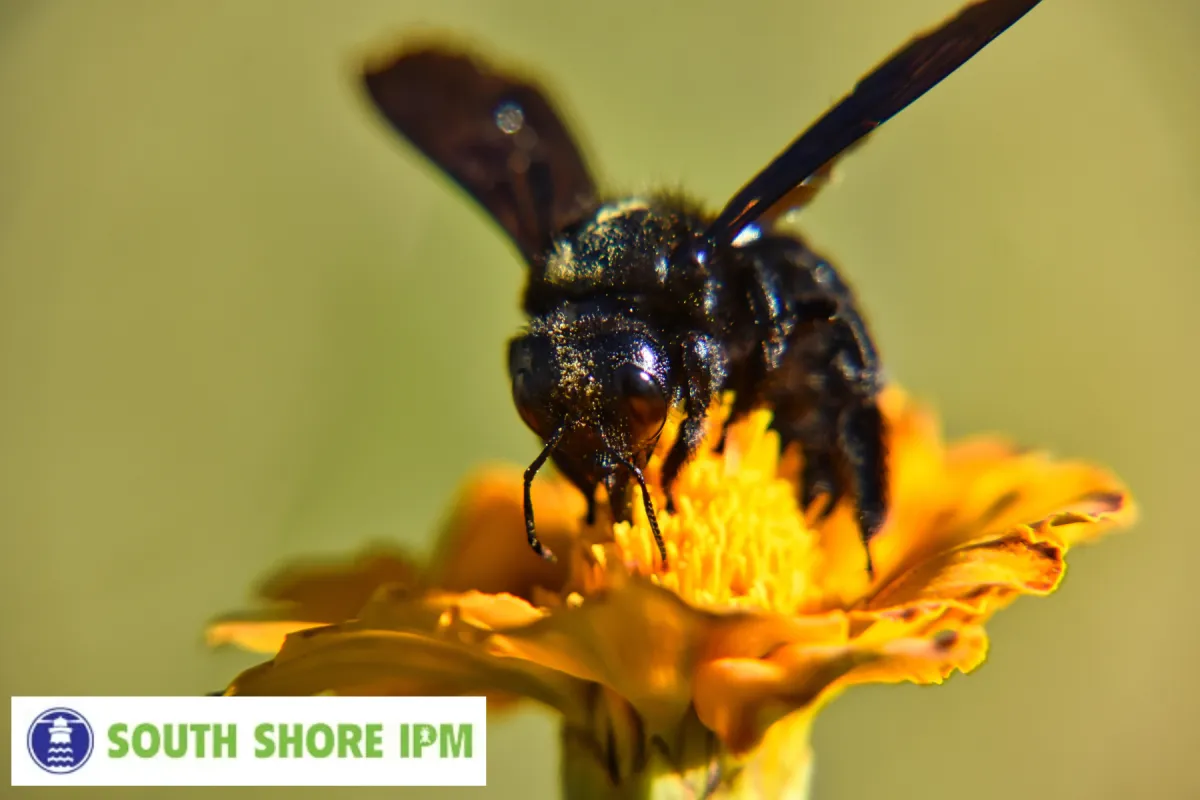
Why Do Carpenter Bees Return to the Same Nesting Sites Year After Year
Carpenter bees return to the same nesting sites year after year because overwintering adults survive inside existing wooden galleries and emerge in spring to reuse established tunnels. Additionally, female bees deposit aggregation pheromones inside bored wood, marking established galleries as safe, energy-efficient nesting locations for future generations.
Spring brings warmer weather, blooming flowers, and bustling activity to backyards across New England. Along with songbirds and butterflies, homeowners often notice large, dark bees hovering around wooden decks, porch eaves, fascia boards, and outdoor furniture. These insects are carpenter bees, and if you feel like you are seeing them target the same spots on your home year after year, your eyes are not deceiving you.
Unlike honeybees or bumblebees that build soft wax or paper nests, carpenter bees bore directly into solid, unpainted softwoods to raise their young. When female bees discover a suitable piece of wood, they construct elaborate internal tunnels. What many homeowners do not realize is that these tunnels become permanent habitats that host generations of bees over time.
Understanding why these persistent wood-boring insects return to the same spots is key to stopping structural damage. Here is a clear guide to the biology behind carpenter bee site fidelity, common myths about how they use wood, and how professional eco-friendly care protects your home for the long haul.
Reused Existing Galleries vs. New Tunnel Excavation
Reusing established wooden tunnels offers significant biological advantages to female carpenter bees compared to drilling fresh entry holes every spring.
During a recent property evaluation for a homeowner in Hanson, our team inspected a cedar deck where male carpenter bees were actively hovering near the joists. The homeowner had patched the entrance holes with wood putty the previous autumn, but fresh sawdust piles were already forming directly beside the old plugs. The bees had simply bypassed the filled entry points to access the extensive internal gallery network beneath the surface.
Here is how reusing existing wood galleries compares to drilling brand-new tunnels:
| Nesting Factor | Reusing Existing Wood Galleries | Boring New Tunnel Excavations |
| Energy Consumption | Low; requires minimal chewing to expand existing voids | High; excavates wood at 1 inch per week, burning vital metabolic energy |
| Chemical Scent Signals | High concentration of residual aggregation & mating pheromones | None; raw untreated timber lacks established olfactory attraction signals |
| Overwintering Survival Rate | High; sheltered galleries protect adults from freezing winter weather | Moderate to Low; exposed surface wood lacks deep thermal buffer cavities |
| Structural Wood Damage | Exponential; interior branching expands galleries into structural framing | Linear; initial entry hole creates a single 6 to 12-inch blind tunnel |
| Wood Dust (Frass) Accumulation | Heavy accumulation of old frass mixed with new wood shavings | Fresh, light-colored sawdust piles beneath newly drilled entry holes |
The 5 Biological Drivers Behind Multi-Generational Carpenter Bee Site Fidelity
A combination of survival instincts, chemical signaling, and structural conditions drives carpenter bees to return to the same nesting sites every spring.
1. Overwintering Shelter Survival in Existing Tunnels
Adult carpenter bees do not die off when autumn arrives. Instead, male and female bees hibernate together deep inside existing wooden tunnels during winter, emerging from the same entry holes come spring.
2. Persistent Chemical Pheromone & Scent Marking
Female bees line internal tunnel walls with natural pheromones and scent markers. These chemical signals linger inside wood voids for years, guiding emerging offspring and nearby bees back to safe nesting spots.
3. Energy Conservation for Brood Cell Construction
Chewing through solid softwood takes a tremendous amount of physical energy. Reusing and expanding existing galleries allows female bees to save their energy for gathering pollen and laying eggs.
4. Natal Nest Fidelity
Female carpenter bees show strong natal site preference, instinctively returning to lay their own eggs in the same wooden structures where they hatched and developed.
5. Structural Conditioning and Micro-Climate Selection
Unpainted, weathered softwoods, like cedar, pine, redwood, and cypress, provide ideal moisture levels and wood density, signaling a dependable habitat for future generations.
Applying Our South Shore IPM Defense Protocol to Solve This
At South Shore IPM, we believe in delivering eco-friendly, personalized pest solutions that keep your home safe while protecting our local environment. We focus on minimal product use inside your living spaces, relying instead on high-quality exterior treatments that form a protective shield around your home.
Leveraging over 50+ years of experience, our skilled professionals provide fast, comprehensive service through customized strategies and an unwavering commitment to your property’s safety. We use high-quality products specifically chosen to deliver lasting protection for your wooden structures. Homeowners trust our pest control in Hanson, MA services for reliable solutions that help safeguard homes against wood-damaging pests.
Here is how our comprehensive approach addresses returning carpenter bees:
- Detailed Wood & Eave Inspections: Our skilled professionals carefully inspect your eaves, fascia boards, rooflines, and deck framing to locate active entry holes, hidden gallery networks, and early structural wear.
- Deep-Gallery Treatment & Scent Neutralization: Using high-quality products, we treat internal wood galleries directly. This neutralizes residual pheromone scents and targets overwintering insects hiding deep inside the wood before they can expand their tunnels.
- Structural Exclusion & Hole Sealing: After treating internal voids, we seal entrance holes with durable, weather-resistant materials to prevent returning bees from reusing established entry points.
- Creating a Strong Exterior Barrier: We apply an eco-friendly exterior barrier along susceptible wooden perimeters, fascia lines, and porch roofs, preventing new spring queens from drilling fresh entry points.
While working with a family whose cedar siding had suffered recurring damage, our team identified several active gallery networks behind the fascia boards. By treating the internal voids, sealing the entrance points, and applying a protective perimeter shield, we broke the multi-generational cycle and kept their siding completely secure. This comprehensive approach is why homeowners rely on Hanson pest control to protect their properties from recurring wood-damaging pest infestations and prevent future structural damage.
Debunking the Myth: “Carpenter Bees Eat the Wood They Drill Into”
A widespread misconception among homeowners is that carpenter bees eat the wood they bore into, similar to termites or wood-boring beetles.
Here is the truth about how carpenter bees interact with wood:
- Chewing for Shelter, Not Food: Carpenter bees chew through wood purely to create nesting tunnels and brood chambers. They do not ingest or digest the wood fibers.
- Sawdust and Frass Accumulation: As female bees drill into wood, they push out coarse shavings (frass). Seeing small piles of clean sawdust on your deck or patio is a clear sign of active drilling rather than digestion.
- Nectar and Pollen Diet: Adult carpenter bees feed exclusively on flower nectar and pollen. In fact, despite their potential for wood damage, they serve as valuable pollinators for local gardens and wildflowers.
Carpenter Bee Biological Specifications & Glossary
Understanding key biological terms helps clarify how carpenter bees establish long-term habitats on residential properties:
Gallery
The internal system of bored tunnels within wooden structures where carpenter bees lay eggs, store food, and hibernate through winter.
Frass
Coarse, sawdust-like wood shavings mixed with waste that female bees push out of entry holes while excavating galleries.
Natal Fidelity
The biological drive that prompts insects to return to their original birth site to mate, build nests, and reproduce.
Pollen Loaf (Bee Bread)
A compacted mixture of nectar and pollen placed inside individual brood cells to nourish developing larvae.
People Also Ask (FAQ)
Why do carpenter bees hover near people on decks and porches?
The hovering bees you see near decks are usually males guarding established nesting sites. Male carpenter bees are protective of their territory, but they are completely harmless because they lack a stinger.
Can painting or staining wood stop carpenter bees from returning?
Yes. Painting or applying a thick exterior sealant covers raw wood fibers and masks natural scent cues, making timber far less attractive to boring female bees.
What happens if you plug a carpenter bee hole without treating inside first?
Plugging an active hole without treating the internal gallery can trap live bees inside. Trapped insects will chew new exit holes through surrounding wood, drywall, or plaster, causing additional structural damage.
Protect Your Wooden Structures from Long-Term Damage
Understanding why carpenter bees return to the same spots year after year shows why simply filling entrance holes is rarely enough. To break the cycle of multi-generational wood damage, home structures require deep-gallery treatment, scent neutralization, and durable exterior protection.
At South Shore IPM, we take pride in offering friendly, eco-conscious pest control tailored to your family’s needs. Our team relies on minimal indoor product use, robust exterior defenses, and personalized care to give you long-term confidence in your home’s safety.
Whether you need specialized pest control in Hanson, targeted treatment, or complete seasonal protection, we are here to support you every step of the way. For reliable, eco-friendly home care, count on our experienced professionals to keep your living space safe and pest-free.
Ready to protect your decks, eaves, and fascia boards from recurring wood damage? Contact us today to schedule your consultation or request a free quote with South Shore IPM!


